Monday, September 26, 2016

Ariel Varges and his Moy & Bastie Movie Camera (1916)

From 1916 newsreel cameraman Ariel Varges was attached to the British army. He filmed the operations of the Expeditionary Force at Salonika (Thessaloniki), Greece, and later covered the war in the Middle East and Mesopotamia. Varges previously featured in a chapter on the American cameramen with the Entente in our book American Cinematographers in the Great War.


Ariel Varges in the trenches at Salonika, 1916. Colorized picture

Link to low res image


'Simple - Efficient - Reliable'


Because of his work with the British during World War I the Imperial War Museum has a remarkable collection of pictures taken by Varges. Of special interest are two photographs, showing Varges with his motion picture camera at the frontline. Varges cranked a Moy & Bastie, a model that was first used in 1909 and became very popular in the film industry. In fact, the first regular "Hollywood" film was shot with a Moy & Bastie. Described in their catalogue as 'Simple - Efficient - Reliable', the Moy & Bastie was a professional hand crank 35 mm motion picture camera in the English 'upright style'. The box was constructed from mahogany and had two internal 400 foot film magazines. Focusing was achieved by viewing the image through the film via a tube from the rear. The camera utilized a unique film transport featuring the 'drunken screw' movement to achieve film pull-down. The Moy & Bastie camera was well known for its impressive chain driven movement and brass gear wheels.

Varges must have followed army regulations when he used this movie camera because the Moy & Bastie was the official model for cinematographers who were attached to the British army. Malins and McDowell used the same type of camera when they shot The Battle of the Somme (1916).


Captain Varges (right) with assistant in forward trenches at the front in Mesopotamia, 1917 

Link to low res image


Apart from the information on the type of camera, the two pictures are also interesting because the photographs show the dangers of filming at the firing line. To protect himself Varges used an armour plate that was set up in front of his camera.

Varges featured before in this weblog. Here is a link to an earlier story.

Also, here is a YouTube video, explaining how the movie camera was operated.


Postscript January 27, 2017:

Battle of the Somme Movie Camera on Display


A Moy & Bastie film camera which is thought to have been used to shoot the famous Battle of the Somme film from 1916 was on display last year at the Imperial War Museum. The camera is in the collection of the Bill Douglas Cinema Museum at the University of Exeter but was loaned to the Imperial War Museum for their exhibition Real to Reel: A Century of War Movies. The camera is signed inside one of the magazines by the great wartime cameraman J.B McDowell, who filmed some of the combat sequences that make up the film.




Monday, September 5, 2016

Shooting War - The U.S. Signal Corps in France

In April 1917, the U.S. Army Signal Corps was designated as the sole official agency responsible for obtaining photographic coverage of America's participation in the Great War. The stated purpose of still and motion-picture film documentation was for use in propaganda and in scientific and military reconnaissance, but it was principally for the production of a pictorial history of the conflict.


Lt. Edwin F. Weigle (left), Photographic Officer U.S. Signal Corps, with the 35th Division in France, 1918/1919. Colorized photo courtesy Cooper C. Graham

Link to high res image


As described in our book American Cinematographers in the Great War, the expansion of the Signal Corps into the official pictorial coverage of the First World War was slow and painful. The army's main interest in motion pictures was for training and observation. The idea of making suitable pictures at the western front to boost morale in the USA was of secondary interest. Lacking cameramen and the proper equipment it took almost a year before the first motion pictures from France were ready for exhibition in the United States.


Signal Corps film (1919) from the CBS Collection at the National Archives


By the end of July 1917, a laboratory was secured by the Signal Corps in Paris for developing and printing both motion and still pictures. This laboratory served until February 1918, when photographic operations were transferred to a larger location in Vincennes near Paris. Starting with 25 men, the Photographic Section grew in strength to 92 officers and 498 enlisted men by the time of the Armistice in November 1918. An operational photographic unit consisted of one motion-picture cameraman and one still-picture photographer, with an appropriate number of assistants. One photographic unit was assigned to each of the American divisions in France.

Battlefilm

Overall, U.S. Signal Corps cameramen during World War I shot roughly 590,000 feet of film. Phillip Steward for his book Battlefilm did an extensive inventory of these official films which are now at the National Archives in Washington, DC. He listed 993 reels and 488 film titles. In 1936-1937 these films had been culled and re-edited by the Army to combine them into a single subject basis series. The result was the "Historical" series of World War I Signal Corps films with catalog numbers between H-1100 and H-1558. Steward recently added more World War I Signal Corps film to this inventory. In April 2018, he published an article on these films, celebrating the World War I "movie men". His article was printed in the U.S. National Archives' "Prologue" magazine. Here is a download link.


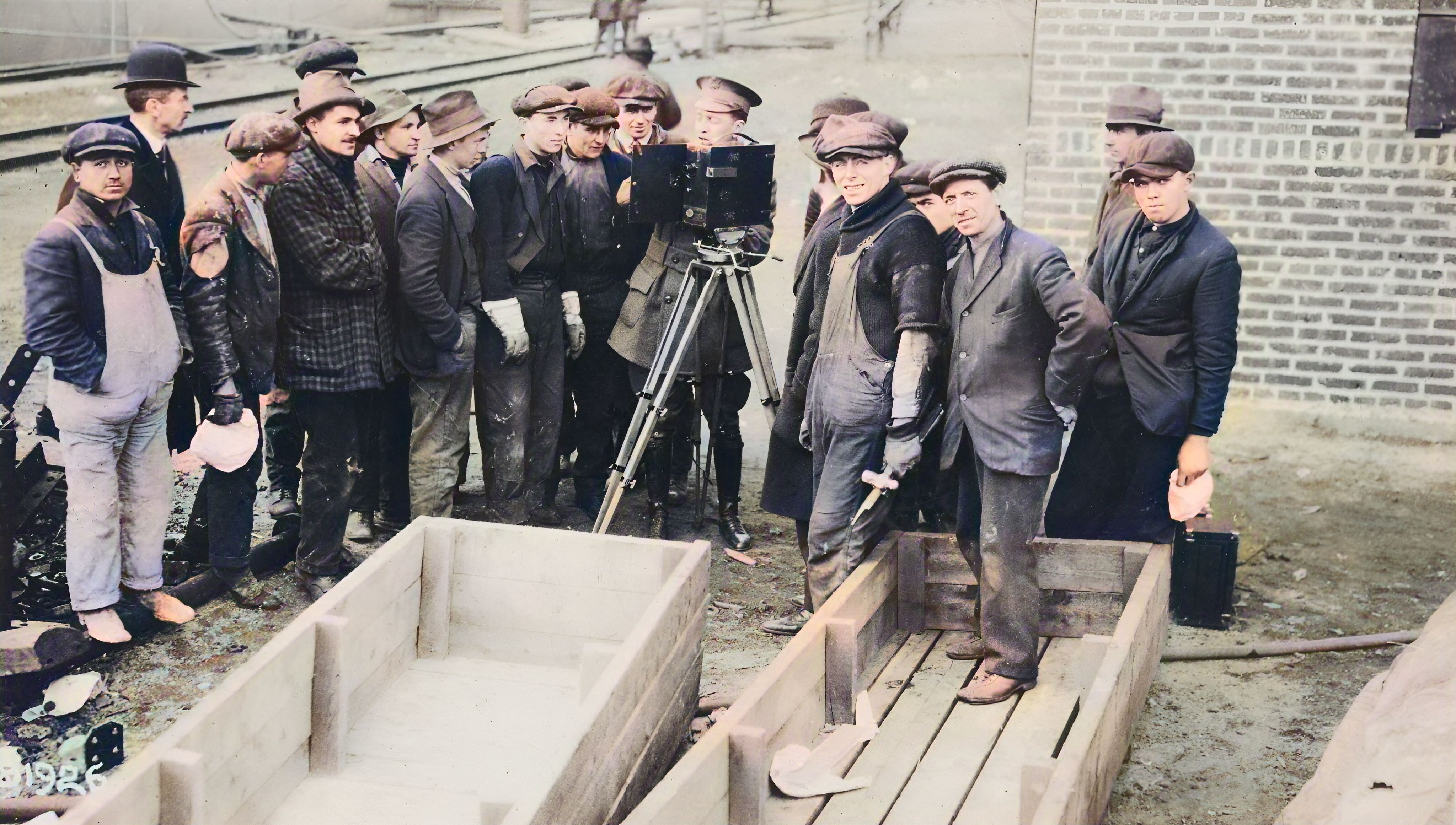
Capt. Albert K. Dawson, U.S. Signal Corps, behind his movie camera. Colorized picture taken in December 1917 at Cramps Shipyard, Philadelphia. Source: National Archives, Washington, D.C. 


Link to original high res image


Despite the enormous amount of film footage in the Signal Corps collection, there is little film showing the actual photographic work by the Signal Corps in World War I. The authors however did find two reels which are of special interest. Printed on 35 mm and running 1333 feet, the footage shows Signal Corps cameramen at work, the operations at the Signal Corps photographic laboratory as well as various inspections, parades and close ups of the men behind these war pictures.


Lt. Edwin F. Weigle, U.S. Signal Corps, testing the Akeley "pancake" camera. Picture taken December 1917 by Albert K. Dawson. Source: Photoplay Magazine, August 1918
Link to trade paper article


In February 1919, the Signal Corps decided to produce an historical record of their own photographic work in France. For this reason a motion picture cameraman and a still photographer were assigned to record these scenes.


A selection of scenes from these films, as well as the corresponding still photographs, has been uploaded on our YouTube channel. We added contemporary World War I music to this clip.


Friday, August 26, 2016

World War I Centennial Premiere: "America's Answer" (USA, 1918)

The most succesful official war film released by the American government during World War I, America's Answer (1918), now is an odd relic from the past. Watching this movie after almost one hundred years feels strange. As Kevin Brownlow noted in his book The War, the West and the Wilderness: "Amused by the titles, intrigued by the antiquity of the equipment, a modern audience can sense none of the manipulative power that the film once had."


Edgar B.  Hatrick (left) on the Western Front near Sommedieue, France, April 1918. In the middle: Sergeant Adrian C. Duff, U.S. Signal Corps. Colorized photo from the U.S. Signal Corps Collection, National Archives

Link to original high res image


America's Answer was released in November 1918 by the Commitee on Public Information (CPI), America's wartime propaganda agency. The movie was distributed by the World Film Corporation in 34 cities and grossed over $135,000. The footage was shot by military cameramen of the U.S. Signal Corps.


Opening scene America's Answer (1918)


First Showing in Paris

An intriguing story about America's Answer has never been told before: the movie was first shown in France, not in the U.S.A. It was first exhibited at the Gaumont Palace in Paris on June 26, 1918, to a a special audience including Field Marshal Joffre as well as the British and American ambassador. The man who was very much instrumental in producing this movie also hasn't been mentioned before: Edgar B. Hatrick, head of Hearst's I.N.S. photo and newsreel service. In April 1918, the CPI sent Hatrick to France to report on the motion picture coverage of the war by the U.S. Signal Corps. His film work in France has been described in more detail in our book American Cinematographers in the Great War.

According to this trade paper report in Moving Picture World, Hatrick was sent to Europe as a special representative of George Creel, chairman of the Committee on Public Information, America's wartime propaganda agency. He was given a six months leave of absence by his chief William Randolph Hearst. While supervising the production of war films, Hatrick was accompanied by cinematographer C..J. Hubbell. During this time in France Hatrick also reportedly supervised principal photography for America's Answer.

Here is Hatrick's own story about making this movie, as published in the trade paper Moving Picture World of August 17, 1918 and in the Washington News, September 1918.


Footage from America's Answer is hard to find on the Internet. The Imperial War Museum has four reels of a British version online, and although a good copy it isn't the complete movie as shown on the screen in 1918. The authors found an original print in the files of the National Archives in College Park, MD, and we uploaded all nine reels of this historic movie on America's involvement in World War I.

After almost one hundred years the film is now in the public domain and available to all on the Internet.


Monday, August 15, 2016

The Cameramen of the k.u.k. Kriegspressequartier

As far as pictorial publicity is concerned, compared to other belligerents the Austro-Hungarian Monarchy during World War I was remarkably well advanced. As early as July 28, 1914, a military press office was set up - the k.u.k. Kriegspressequartier - which even admitted women to the front as official war artists.

As described in our latest book, American cinematographers Albert Dawson, Frank Kleinschmidt and Edwin Weigle wouldn't have been able to make their war films without the assistance of this press office. As embedded camera reporters they accompanied the Austro-Hungarian army on the eastern front, in the Balkans and at the Isonzo front where from 1915 the Italian army tried to break through the Alpine mountain passes.


Franz Pachleitner and his photographic outfit, 1914. From the World War I collection of the Austrian National Archives

Link to low res image


To commemorate the Great War the Austrian TV network ORF2 in September 2014 broadcasted a documentary on the k.u.k. Kriegspressequartier, featuring the work by two Austrian cameramen, Alexander Exax and Franz Pachleitner. Exax's pictures were discovered by photo historian Anton Holzer in the archives of the Austrian National Archives. Exax was just 18 when he joined the army and the youngest war photographer at the press office at that time. In his diary he described his experiences in Galicia, Serbia and on the Isonzo front. The Austrian TV documentary shows how his pictures were identified at the Austrian National Archives which still has over 33.000 photographs produced by the military press office.


Setting up movie camera, April 1915. Picture taken by American war correspondent Frank Kleinschmidt with the Austro-Hungarian forces. Courtesy Austrian State Archives. Colorized photograph

Link to original low res image


Kaiser, Krieg und Kamera

Franz Pachleitner from 1914 pioneered in aerial photography. At the outbreak of war he was assigned to Fliegerkompanie Nr. 10 at Graz-Thalerhof Airport. Most of his pictures were taken at the eastern front in Galicia and the Carpathian mountains. In 1916 Pachleitner taught aerial photography at the military academy in Vienna and from 1917 he covered the war against the Italian army. Despite strict censorship he smuggled most of his war pictures back to Austria, which were kept in the family archives. Shortly before his death he had his war memoirs Kaiser, Krieg und Kamera written down by his granddaughter, Carina Klemmer. Pachleitner's war pictures have been uploaded on the Internet by the Austrian National Archives and can be viewed here. His book can be ordered here.

During our research we found several interesting pictures of K.u.K photographers in the field during World War I. These are all from the National Archives in Vienna. Here is a link to our photo album.

Also, here is a video showing the work by these official cameramen from the Austro-Hungarian military press office of World War I, edited from the ORF2 documentary.