Monday, October 24, 2016

Wolfgang Filzinger - War Front Cameraman, 1914-1918

As a result of the centennial of the First World War, European archives have digitized over 3.000 contemporary films on the Great War on the European Film Gateway. The webportal is a true bonanza for film history fans all over the world. As part of this project, the German Film Institute uploaded a remarkable collection on war front cameraman Wolfgang Filzinger.


Filzinger and his Ernemann- A movie camera, March 1915. Note the short tripod

Link to low res image


Born in Dresden in 1889, Filzinger became involved in building the first Pathé movie theatre in Paris in 1911. When war broke out in 1914 he was assigned as a cinematographer for one of the private film companies, presumably Messter, to report on the war. Filzinger left three photo albums that show him and his film team at the western front. He also reported on his film work in the German trade papers. The collection is of great importance to World War I film history.

Cloaking Device

Throughout the war Filzinger cranked an Ernemann-A camera which was built in Dresden. In his photo album there is a picture showing him at the Pontfaverger airfield, France, in March 1915, using a short tripod. This handy tripod came into use a lot, as it allowed filming in recumbent positions which reduced the danger of Filzinger becoming a target. In his articles Filzinger also reported on cloaking devices he invented and employed to shelter himself from both German soldiers staring curiously into the camera, thus destroying the aura of authenticity, as well as enemies spotting him. Other safety measures he employed included a system of mirrors he installed in dug-outs so he could film without risk.


Filzinger in the trenches at the Western Front

Link to low res image


There is a sketch by Filzinger showing this cloaking device in his article for Lichtbild-Bühne. "In order to shoot in a trench", he reported, "you have to be familiar with the conditions. It is not easy to find a suitable spot in a trench. It is best to film through an embrasure or from an observation stand. The cranking of the camera is a dangerous business, as it can easily happen that one is hit by shrapnel when shells detonate nearby."

Filzinger's images show how the size and weight of the camera and tripods restricted the work of the operator, which is why action often had to be captured from a fixed viewpoint in the distance using a wide angle. This wide angle would also allow operators to capture spectacular events or detonations, as one was always unsure where exactly they would occur. As a consequence the aesthetic quality of such images in terms of composition or depth of field was often mediocre. It is known from his reports that Filzinger tried to improve the visual quality of his footage by working on the diaphragm control of his object lens.

After the war Filzinger continued his work in the film sector and is known mostly for conducting early sound film experiments with the Swedish film pioneer Sven Berglund. He died in 1951.

Filzinger's original manuscript in German on his experiences filming the Great War can be downloaded and read here.

Monday, October 10, 2016

Lost & Found: The German Navy Filmed by Nelson E. Edwards (1916)

While doing research at the Military Archives in Freiburg, Germany, authors Cooper C. Graham and Ron van Dopperen in February 2016 found a complete list of movie scenes shot by American cinematographer Nelson E. Edwards, showing the German Navy and close ups of Admiral Scheer and von Hipper. The historical footage was taken in June 1916, shortly after the battle of Jutland. A month before our research trip to Freiburg we also identified some of these scenes online.


Nelson Edwards, filming Admiral von Hipper, June 1916. From American Cinematographers in the Great  War (2014). Colorized photograph, courtesy Wiegman family 

Link to original high res image


This discovery makes it possible for the first time to reconstruct how Edwards filmed the aftermath of the largest naval battle in World War I and how these scenes were shown in the American and German movie theaters in the summer of 1916.

Edwards's film work in wartime Germany has been described in more detail in our book American Cinematographers in the Great War. He ranked among the first, pioneering newsreel cameramen in American film history. From 1914 Edwards filmed for Hearst International News Service and covered the Mexican Revolution. In 1916 he filmed the Turkish and the German side of the World War. He was also chief cameraman for Fox Newsreel during the year of its birth, and thereafter a longtime stringer for Paramount News.


Clippings from Edwards' personal collection on his film work with the German Navy. Courtesy Wiegman family


The Battle of Jutland

When Edwards shot these naval scenes the Germans were in a celebratory mood. They had just fought the battle of Jutland against the British Navy, and although the outcome was indecisive the Germans claimed victory because they had destroyed more enemy ships. To celebrate the event Edwards was invited by the German naval publicity bureau to visit the fleet. The list that we found was cleared on June 29, 1916, by Captain Hans Wittman, a naval publicity officer. Wittman must have been impressed by Edwards' film work because earlier in 1916 he had struck a deal with the German foreign propaganda agency - the Zentralstelle für Auslandsdienst - to use films shot by Edwards of the Turkish army.

The list that was cleared by Wittman has a total of 35 movie scenes all showing the German Navy. The footage by Edwards has a length of 1400 feet. Edwards filmed Admiral Scheer's flagship, as well as the officers of the German Naval High Command, who were proudly posing before his movie camera. In one of the scenes can be seen a young officer, Erich Raeder. He served as Admiral von Hipper's chief of staff in 1916, and during the first part of the Second World War was Hitler's top naval commander.


Scene from one of Edwards' films: Admiral von Hipper adressing his men


Edwards also filmed numerous battle ships on the high sea. Those listed by name are the battleships Westfalen that destroyed six British torpedo boats, as well as the Kaiser Wilhelm II. He also filmed German torpedo boat destroyers in action, sailors signalling to other ships, excercises on board the German fleet and the daily life of the German sailors. In America Edwards' newsreel films were released in the movie theaters in August 1916.

Scenes Found by the Authors

The scenes that we could identify on the list and that were retrieved online are numbers 13, 14, 17 and 18. These show Admiral von Hipper and his staff, as well as Admiral Scheer visiting his flag ship Friedrich der Grosse. The intertitle introducing the scene showing Scheer boarding the ship - a very short flash on film - has a reference to the Hearst International News Pictorial, the company Edwards worked for and further evidence that he shot these scenes. The footage is on 35 mm and the original negatives are from the Grinberg Collection. A print positive was bought for stock purposes by Getty Images. The original footage from Grinberg was also used by the BBC in episode 14 of the Great War series (1964).

We have uploaded a research copy of the film clip on our YouTube channel, including the film scenes shot by Edwards that were used by the BBC in the 1960s.

The list from the Military Archives in Freiburg, describing the naval scenes taken by Edwards, can be read and downloaded here.


Monday, September 26, 2016

Ariel Varges and his Moy & Bastie Movie Camera (1916)

From 1916 newsreel cameraman Ariel Varges was attached to the British army. He filmed the operations of the Expeditionary Force at Salonika (Thessaloniki), Greece, and later covered the war in the Middle East and Mesopotamia. Varges previously featured in a chapter on the American cameramen with the Entente in our book American Cinematographers in the Great War.


Ariel Varges in the trenches at Salonika, 1916. Colorized picture

Link to low res image


'Simple - Efficient - Reliable'


Because of his work with the British during World War I the Imperial War Museum has a remarkable collection of pictures taken by Varges. Of special interest are two photographs, showing Varges with his motion picture camera at the frontline. Varges cranked a Moy & Bastie, a model that was first used in 1909 and became very popular in the film industry. In fact, the first regular "Hollywood" film was shot with a Moy & Bastie. Described in their catalogue as 'Simple - Efficient - Reliable', the Moy & Bastie was a professional hand crank 35 mm motion picture camera in the English 'upright style'. The box was constructed from mahogany and had two internal 400 foot film magazines. Focusing was achieved by viewing the image through the film via a tube from the rear. The camera utilized a unique film transport featuring the 'drunken screw' movement to achieve film pull-down. The Moy & Bastie camera was well known for its impressive chain driven movement and brass gear wheels.

Varges must have followed army regulations when he used this movie camera because the Moy & Bastie was the official model for cinematographers who were attached to the British army. Malins and McDowell used the same type of camera when they shot The Battle of the Somme (1916).


Captain Varges (right) with assistant in forward trenches at the front in Mesopotamia, 1917 

Link to low res image


Apart from the information on the type of camera, the two pictures are also interesting because the photographs show the dangers of filming at the firing line. To protect himself Varges used an armour plate that was set up in front of his camera.

Varges featured before in this weblog. Here is a link to an earlier story.

Also, here is a YouTube video, explaining how the movie camera was operated.


Postscript January 27, 2017:

Battle of the Somme Movie Camera on Display


A Moy & Bastie film camera which is thought to have been used to shoot the famous Battle of the Somme film from 1916 was on display last year at the Imperial War Museum. The camera is in the collection of the Bill Douglas Cinema Museum at the University of Exeter but was loaned to the Imperial War Museum for their exhibition Real to Reel: A Century of War Movies. The camera is signed inside one of the magazines by the great wartime cameraman J.B McDowell, who filmed some of the combat sequences that make up the film.


Monday, September 5, 2016

Shooting War - The U.S. Signal Corps in France

In April 1917, the U.S. Army Signal Corps was designated as the sole official agency responsible for obtaining photographic coverage of America's participation in the Great War. The stated purpose of still and motion-picture film documentation was for use in propaganda and in scientific and military reconnaissance, but it was principally for the production of a pictorial history of the conflict.


Lt. Edwin F. Weigle (left), Photographic Officer U.S. Signal Corps, with the 35th Division in France, 1918/1919. Colorized photo courtesy Cooper C. Graham

Link to high res image


As described in our book American Cinematographers in the Great War, the expansion of the Signal Corps into the official pictorial coverage of the First World War was slow and painful. The army's main interest in motion pictures was for training and observation. The idea of making suitable pictures at the western front to boost morale in the USA was of secondary interest. Lacking cameramen and the proper equipment it took almost a year before the first motion pictures from France were ready for exhibition in the United States.


Signal Corps film (1919) from the CBS Collection at the National Archives


By the end of July 1917, a laboratory was secured by the Signal Corps in Paris for developing and printing both motion and still pictures. This laboratory served until February 1918, when photographic operations were transferred to a larger location in Vincennes near Paris. Starting with 25 men, the Photographic Section grew in strength to 92 officers and 498 enlisted men by the time of the Armistice in November 1918. An operational photographic unit consisted of one motion-picture cameraman and one still-picture photographer, with an appropriate number of assistants. One photographic unit was assigned to each of the American divisions in France.

Battlefilm

Overall, U.S. Signal Corps cameramen during World War I shot roughly 590,000 feet of film. Phillip Steward for his book Battlefilm did an extensive inventory of these official films which are now at the National Archives in Washington, DC. He listed 993 reels and 488 film titles. In 1936-1937 these films had been culled and re-edited by the Army to combine them into a single subject basis series. The result was the "Historical" series of World War I Signal Corps films with catalog numbers between H-1100 and H-1558. Steward recently added more World War I Signal Corps film to this inventory. In April 2018, he published an article on these films, celebrating the World War I "movie men". His article was printed in the U.S. National Archives' "Prologue" magazine. Here is a download link.


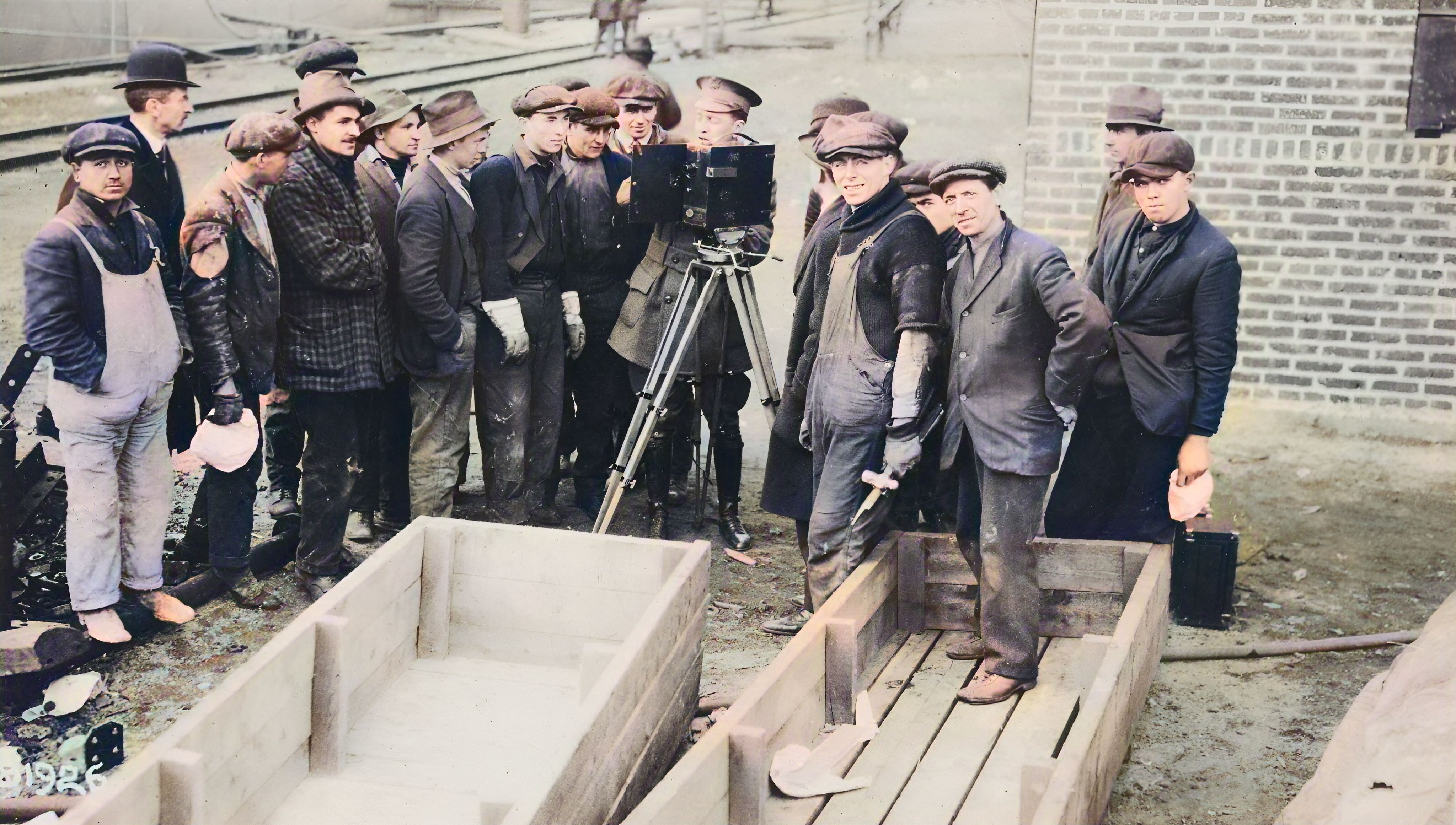
Capt. Albert K. Dawson, U.S. Signal Corps, behind his movie camera. Colorized picture taken in December 1917 at Cramps Shipyard, Philadelphia. Source: National Archives, Washington, D.C. 


Link to original high res image


Despite the enormous amount of film footage in the Signal Corps collection, there is little film showing the actual photographic work by the Signal Corps in World War I. The authors however did find two reels which are of special interest. Printed on 35 mm and running 1333 feet, the footage shows Signal Corps cameramen at work, the operations at the Signal Corps photographic laboratory as well as various inspections, parades and close ups of the men behind these war pictures.


Lt. Edwin F. Weigle, U.S. Signal Corps, testing the Akeley "pancake" camera. Picture taken December 1917 by Albert K. Dawson. Source: Photoplay Magazine, August 1918
Link to trade paper article


In February 1919, the Signal Corps decided to produce an historical record of their own photographic work in France. For this reason a motion picture cameraman and a still photographer were assigned to record these scenes.


A selection of scenes from these films, as well as the corresponding still photographs, has been uploaded on our YouTube channel. We added contemporary World War I music to this clip.