Crowd funded by World War I and film history fans alike, Beaumont-Hamel was released online on June 30, 2018. The film has a unique approach to the Great War. The Battle of the Somme is seen here through the lens of the official cinematographer, Geoffrey Malins, who on July 1, 1916, covered the bloodiest battle in British military history.
Co-directed by a film maker (Ross Barnwell) and a World War I historian (Andy Robertshaw, co-author of Ghosts on the Somme), this short film places historical accuracy at the centrepiece of the drama. Highly recommended!
In the collection of the Imperial War Museum the authors recently found a remarkable film by photographic officer Captain Edwin H. Cooper, showing his preparations for a staged battle between the American ace Eddie Rickenbacker and a captured German plane. During the making of this movie Cooper's plane crashed but he survived miraculously.
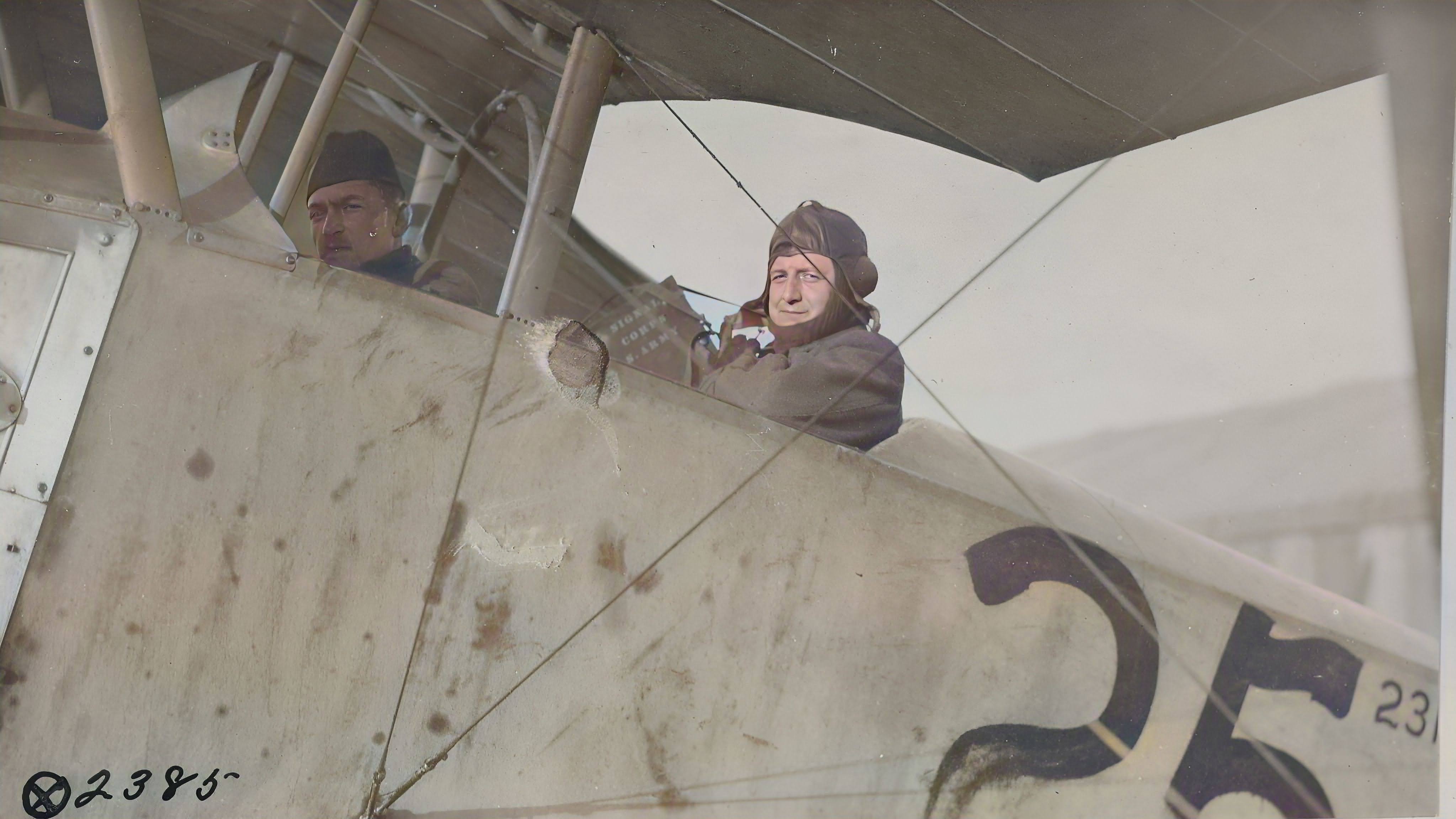
Lieutenant Edwin H. Cooper, getting ready for a motion picture flight. Aviation School, Issoudon, 12 December 1917. Colorized Signal Corps picture, courtesy Harry B. Kidd
Distinguished Service Cross for Extraordinary Bravery
Edwin H. Cooper (1881-1948) featured before in this weblog. He was the photographic officer with the 26th "Yankee" Division and in 1917 Cooper was one of the first official cameramen to land in France with the American Expeditionary Force. In a previous weblog we described how Cooper risked his life while filming the American attack on Château-Thierry. He was awarded the Distinguished Service Cross for his extraordinary bravery during this offensive. Cooper also appears in a recent documentary that we produced - Mobilizing Movies! - on the U.S. Signal Corps cameramen of the First World War.
In his memoirs Cooper explained how he got interested in aerial photography. When he landed at St. Nazaire in October 1917 one of the first things he noticed was a huge observation balloon above the harbor. He immediately decided he wanted to experience the thrill of covering the war from above: "We passed over a very beautiful little chateau which reminded me of a toy house in a well kept Christmas yard. The coast of Brittany is very rocky, jutting out into the water, which was a most wonderful blue. This was the most beautiful ride I ever had. On reaching St. Nazaire we circled over the town, the pilot maneuvering so we could approach the pile of automobiles by making a long glide and at the proper time for me to crank the motion picture camera. I made a mistake by putting my hand up broadside to grasp the crank. The wind pressure was so great that it snapped my hand back, hitting me in the face, and I had to offer my hand knife-wise against the wind, and even at that the cranking was very difficult."
Capturing the American Aces
In December 1917 Cooper went to Issoudon, the training camp for American aviators. There he met most of the American aces, such as Eddie Rickenbacker, Jimmy Meissner and President Roosevelt's son, Quentin. Many of these men he would encounter again at the 94th Aero-Squadron near Toul. Cooper pictured the training period for the aviators, starting with the roulier class. This was a plane with the propellers clipped to keep the machine from rising from the ground. From there he followed the training of the aviators from one field to another and finally to the acrobatic field. Each day he was in the air and by then he had decided he wanted to join the Air Service.
Major Raoul Lufbery at the 94th Aero-Squadron, photographed by Lt. Edwin Cooper on April 18, 1918. Colorized Signal Corps photograph courtesy Harry B. Kidd
Lieutenant Cooper was by all accounts a fearless aerial photographer. Because of his audacity he was admitted as a charter member of the Gimper Club at 94th Aero-Squadron. To join this exclusive club one had to do a stunt or be a true ace. There is a picture of these club members, taken in the summer of 1918, including Lt. Cooper together with his friend Eddie Rickenbacker. Judging from a report in the trade press, Cooper must have qualified for the Gimper Club not because he had shot down German planes but as a result of his remarkable stunts: "To get a proper focus, he would climb out of his seat in an airplane, slid out to the tail of the machine, and there complete his work. His weight had caused the tail to dip, and the pilot had to loop the loop several times to save their lives", the Bulletin of Photography reported in October 1918.
Lost footage found at Critical Past and the Imperial War Museum
The opening movie scenes that we found are from the Imperial War Museum and were taken on October 18, 1918 when Cooper had just been promoted to Captain. You see him fitting his Debrie motion picture camera to a gun position inside the cockpit of a Liberty plane. Cooper went up in a two-seater together with Jimmy Meissner that day. Rickenbacker in his book Fighting the Flying Circus (1919) described how their plane crashed a couple of miles outside of the aerodrome. "We hurried over, expecting to find the occupants badly injured, as the Liberty appeared to be a total wreck. But out stepped Jimmy and Captain Cooper, neither of them the worse for their experience. And to complete our surprise, the camera, although covered with the débris of the machine, was quite unhurt!"
The wrecked Liberty plane, showing Cooper's movie camera atached to the observer's seat. Photographer: Sgt. Gideon Eikleberry, Signal Corps cameraman, 26th Division, A.E.F. Location: Rembercourt, Meurthe et Moselle, France. Date: October 18, 1918. Colorized photograph, courtesy Harry B. Kidd
Undaunted by the crash Cooper three days later again cranked his movie camera while filming a staged battle between Rickenbacker inside a Spad and a captured German plane. This time his flight had a safe landing. Cooper's film of this duel in the sky has been found in the stock collection of Critical Past. The original footage must have looked quite spectacular. In order to make the dogfight look realistic the planes shot special tracer bullets. At the end of the film when the German plane went down landing flares that had been fitted under the wings were set on fire. According to Rickenbacker, the German plane even had a dummy pilot installed that was thrown out of the aircraft as the plane dived down. Rickenbacker mentioned the fighting looked so real a French artillery unit opened fire, mistaking the German plane for a real enemy aircraft. Cooper's historic footage also has a close-up of pilot Jimmy Meissner in the front seat of his plane.
We have edited these scenes from the Imperial War Museum and Critical Past on our YouTube channel. Enjoy!
On September 9, 1919, a group of Signal Corps cameramen was assigned to take pictures of General John J. Pershing, commander of the American Expeditionary Force in World War I. While posing for this film and photo opportunity Pershing showed his typical sense of humor.
General Pershing poses for U.S. Signal Corps cameramen. New York City, September 9, 1919. Signal Corps Collection, National Archives, Washington, D.C. Record number 111-SC-62677. Colorized picture
There was a reason why Pershing had to deal with all these cameramen. The next day he was going to lead a victory parade down New York City’s Fifth Avenue. Vast crowds would cheer as 25,000 U.S. soldiers who had served in the A.E.F.'s 1st Division marched from 107th Street to Washington Square, wearing trench helmets and their full combat gear.
To prepare for this publicity drive it was decided that the U.S. Army needed to have a new set of still pictures and film close up shots of America's war hero who had recently been promoted to General of the Armies of the United States, the highest rank possible for any member of the U.S. armed forces. For this special film and photo opportunity Pershing agreed to pose on top of the roof of the Waldorf-Astoria Hotel. For photographers General Pershing may have been a perfect model because of his striking looks and impressive appearance. But people who knew him better were aware of the fact that he never felt quite comfortable in front of a camera. The General evidently wanted to finish the shoot as soon as possible. As Sergeant R.E. Warner took this picture above Pershing said to Lieutenant Sutton, who was grinding his movie camera:
"Do they let you waste all that film on me, Lieutenant?"
This Signal Corps film from the National Archives has scenes showing Pershing leading the 1st "Big Red One" Division down Fifth Avenue the following day on September 10, 1919.
In the film collection at the National Archives in Washington, D.C. the authors recently found one of the earliest American home movies on World War I. Partly based on original footage shot by military cameramen of the U.S. Signal Corps this film series belonged to the War Department but was released on 16 mm. format in 1928 by the Empire Safety Film Co., Inc., located on Seventh Avenue in New York City, for the series "12 Film Monuments.”
Advertisement for the Empire Safety Film World War I series (1928)
The title of this film series refers to twelve important events during World War I for the United States. Each episode was put on a 100 feet reel and was printed on safety stock. The customer could buy a separate reel for $4,50,- The list of this World War I series of shorts is as follows: “Cantigny", "St. Mihiel", "Leviathan”, “Argonne Forest”, “Château-Thierry”, “Zeppelin's Last Raid Over London”, "Exploits of German Submarines" ( four episodes), "Landing at Brest" and "Russia in the World War."
The footage that we found at the National Archives contains part of the original series: "Château-Thierry", "Exploits of German Submarines" (some but not all episodes) and ""Zeppelin's Last Raid." The quality of these pictures is extraordinary and the footage is beautifully tinted.
We uploaded the episodes on Château-Thierry - the A.E.F's first major engagement at the Western Front - and the Zeppelin attack on London on our YouTube channel.
In this previous weblog we also posted on American World War I home movies.