Around October 20, 1918 an estimated 14,000 people gathered in Grant Park, Chicago, for a huge movie project. Friends, relatives and sweethearts of soldiers from the Illinois regiments that were serving in France all gathered to appear before the camera, so the soldiers could see their loved ones on Christmas Eve.
Scene from the "Smile Films": friends and family say hello to Eddie Brand from Chicago. Colorized picture
The project was called "Smiles Films" and judging from contemporary reports it was a terrific morale booster. The idea actually was quite original. Usually films were made in Europe for the American home front, but this time it was the other way around. According to film trade reports, the Chicago Examiner - a Hearst newspaper - came up with this idea and joined forces with the Rothacker Film Company for the making of these special films. As production went underway the scope of the project expanded rapidly. At first the makers of "Smile Films" thought about shooting scenes of friends and relatives of soldiers from the 131rd and 132nd Illinois regiments. Then the Black Hawk Division was added to their list, as well as the 149th Field Artillery, the Marines from Illinois and the Afro-American soldiers. In the end director Rex Weber and his crew produced 34 reels of film, totalling 26,683 feet of film.
"Turning Chicago Upside Down"
When the "Smiles Films" were recorded war on the Western Front was still being fought by the American soldiers and no one could have guessed that the war would be over by Christmas. Sending a personal message over there by using movies was something the boys in the trenches would certainly appreciate. During post-production the footage was edited into segments according to the specific name of the military unit, so the film could be shown to the appropriate soldiers through the YMCA. Each film had an introduction by Governor Lowden and Judge Landis who was quoted on an intertitle urging the boys to "give the Germans both barrels". Director Rex Weber, who had made a series of films in 1917 for the American Military Relief Association, also appeared in these movies, announcing what would happen to Chicago when the soldiers returned home. A scene was projected next, showing the streets of Chicago that were turned upside down by tilting the movie camera.
According to film producer Watterson R. Rothacker, director Rex Weber was thoroughly exhausted by this massive film project. In retrospect that turned out to be an ominous statement. On December 9, 1918, shortly before his movies were shown to the American soldiers in France, Weber died - one of the millions of victims of the Spanish flu that was sweeping across Europe and the U.S. at the time.
Unfortunately, we haven't been able so far to find the footage of these "Smiles Films" in the historical film archives, but in the National Archives in Washington, D.C. we came across a fascinating selection of pictures showing the making of these films in Grant Park, Chicago.
Although they shot thousands of feet of footage you hardly see them on film: the official cameramen of World War I. By a stroke of luck we recently found a rare movie scene that features one of these war photographers: William Fox, commanding the Photo-Unit attached to the 5th Division of the American Expeditionary Force.
William Fox was mentioned in an earlier weblog. He was a press photographer who worked for Underwood & Underwood in New York City. In 1916 Fox was attached to General Pershing's forces as the only official accredited cameraman to cover the Punitive Expedition into Mexico. The National Archives and the Library of Congress in Washington, D.C. have a collection of pictures taken by Fox in Mexico at that time. Here is a selection of these photographs which were uploaded on our photo channel.
Thanks to Harry Kidd's excellent photographic research on the U.S. Signal Corps World War I cameramen we could trace some additional background information on Lieutenant Fox's work after the American entry into the First World War. First, we found two pictures taken by Fox in June 1918 at Newport News, Virginia, when he was covering troop transports to France. Here is a link to one of his photographs, from Harry Kidd's photo channel on Flickr.
Next, as a postscript to this weblog, in 2023 we discovered two pictures in the World War I Signal Corps collection of the National Archives, showing Fox together with Captain Albert K. Dawson, a well known war photographer who had been among the first photographic officers to join the Signal Corps after the American entry into the war. These shots were taken on November 14, 1917, at Camp Leach in Washington, D.C. and show soldiers of the 24th Engineers Battalion on camouflage training. Fox at the time was commissioned into the Signal Corps with the rank of 1st Lieutenant.
The WW1 Signal Corps collection has a picture taken by Fox on July 31, 1918, showing the loading of a beef ship in Hoboken, N.J. There is also this photograph recorded by Fox on August 2, 1918, showing a safe arrival card of an American soldier, which indicates Fox had sailed for France by then. He was assigned to the 5th Division, A.E.F, as photographic officer. Nicknamed "The Red Devils", the 5th Division was activated on December 11, 1917, just over eight months after the American entry into World War I, at Camp Logan, near Houston, Texas and began training for deployment to the Western Front. The entire division had arrived in France by May 1, 1918, and the units were soon deployed into the front line. Battle honors to the Fifth Division were earned for its participation at the St. Mihiel Drive and Meuse-Argonne Offensive.
In October 1918, Lieutenant Fox and his photographic unit reached the Meuse river while the 5th Division was driving the German army out of the Argonne area. Their picture was taken on October 19, 1918, near Montfaucon.
Signal Corps photographic
unit attached to the 5th Division, 1st Army. Personnel, left to right: Sgt 1cl
A. J. Mann; Cpl J. G. Jones, S.C. Motion Picture Photographer; 1st Lt. Wm Fox,
S.C. Still Photographer: Cpl. Paul Bogart, Ass't; and Master Signal Electrician
Gare Schwartz. Fayel Farm near Montfaucon, Meuse, France. Photographer:
Lieutenant Wm. Fox, S.C. Location: Montfaucon, Meuse, France. Date October 19, 1918. Colorized photograph, courtesy Harry B. Kidd
Harry Kidd's research at the National Archives has produced additional references to Fox and his camera crew. On October 22, 1918, he was filmed having lunch with members of his photographic team, as well as with officers of the 5th Division at mess. Here is a download link to the 'dope sheet' movie cards, describing these two scenes. Part of this footage we also found in the collection of the National Archives in Washington, D.C.
Footage Found at the Imperial War Museum
On October 25, 1918, three days later, Fox again was filmed inside the city of Cunel, when he was setting up his movie camera in front of a church that supposedly had been used by the Germans as a cinema. When Fox was filming Cunel had just been evacuated by the retreating Germans, but it seems the place was still dangerous because Fox appears to be running away from shell fire in the film scene that we found in the collection of the Imperial War Museum.
With special thanks to Harry Kidd for his research and input on this weblog
Crowd funded by World War I and film history fans alike, Beaumont-Hamel was released online on June 30, 2018. The film has a unique approach to the Great War. The Battle of the Somme is seen here through the lens of the official cinematographer, Geoffrey Malins, who on July 1, 1916, covered the bloodiest battle in British military history.
Co-directed by a film maker (Ross Barnwell) and a World War I historian (Andy Robertshaw, co-author of Ghosts on the Somme), this short film places historical accuracy at the centrepiece of the drama. Highly recommended!
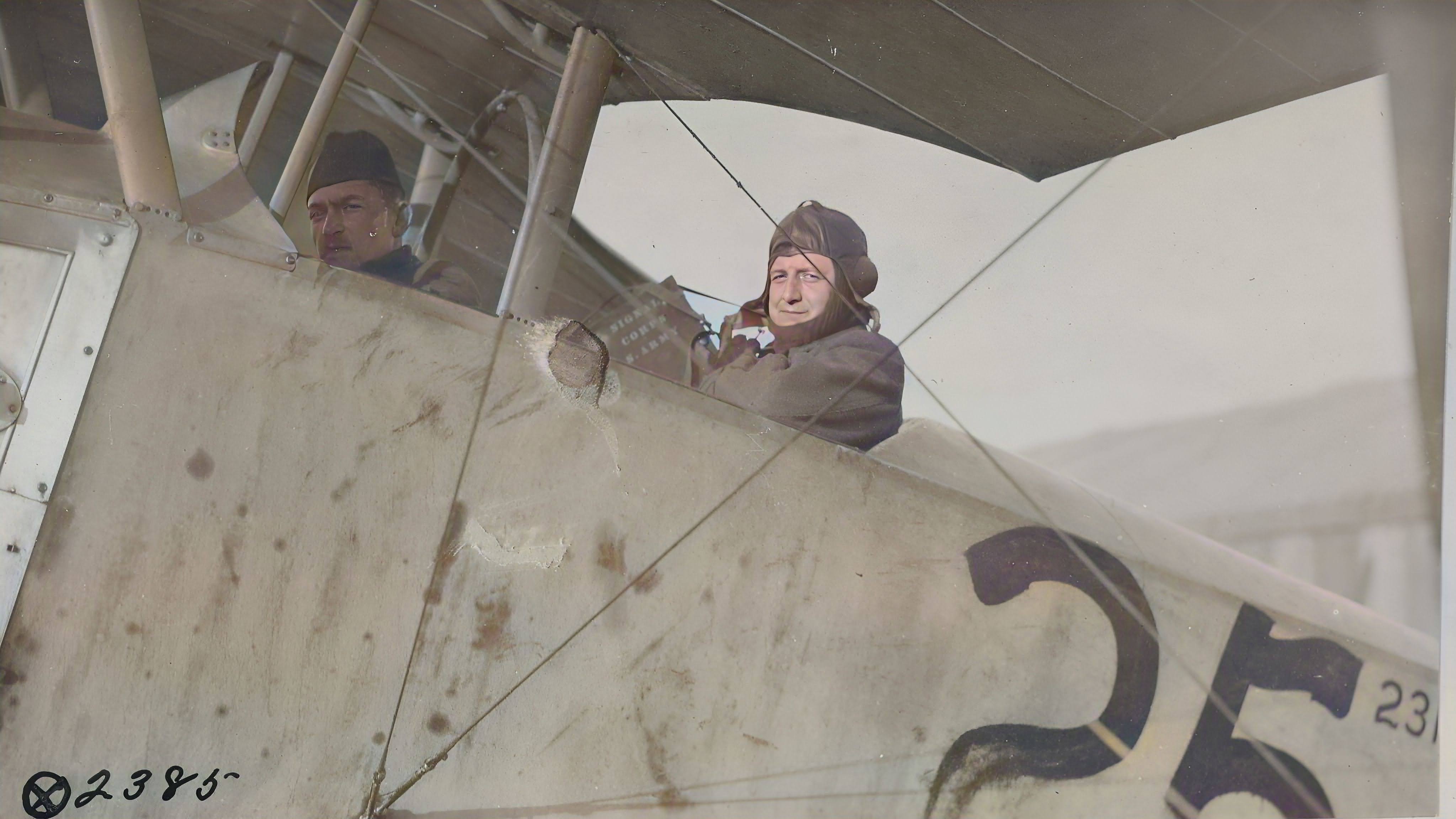
In the collection of the Imperial War Museum the authors recently found a remarkable film by photographic officer Captain Edwin H. Cooper, showing his preparations for a staged battle between the American ace Eddie Rickenbacker and a captured German plane. During the making of this movie Cooper's plane crashed but he survived miraculously.
Lieutenant Edwin H. Cooper, getting ready for a motion picture flight. Aviation School, Issoudon, 12 December 1917. Colorized Signal Corps picture, courtesy Harry B. Kidd
Distinguished Service Cross for Extraordinary Bravery
Edwin H. Cooper (1881-1948) featured before in this weblog. He was the photographic officer with the 26th "Yankee" Division and in 1917 Cooper was one of the first official cameramen to land in France with the American Expeditionary Force. In a previous weblog we described how Cooper risked his life while filming the American attack on Château-Thierry. He was awarded the Distinguished Service Cross for his extraordinary bravery during this offensive. Cooper also appears in a recent documentary that we produced - Mobilizing Movies! - on the U.S. Signal Corps cameramen of the First World War.
In his memoirs Cooper explained how he got interested in aerial photography. When he landed at St. Nazaire in October 1917 one of the first things he noticed was a huge observation balloon above the harbor. He immediately decided he wanted to experience the thrill of covering the war from above: "We passed over a very beautiful little chateau which reminded me of a toy house in a well kept Christmas yard. The coast of Brittany is very rocky, jutting out into the water, which was a most wonderful blue. This was the most beautiful ride I ever had. On reaching St. Nazaire we circled over the town, the pilot maneuvering so we could approach the pile of automobiles by making a long glide and at the proper time for me to crank the motion picture camera. I made a mistake by putting my hand up broadside to grasp the crank. The wind pressure was so great that it snapped my hand back, hitting me in the face, and I had to offer my hand knife-wise against the wind, and even at that the cranking was very difficult."
Capturing the American Aces
In December 1917 Cooper went to Issoudon, the training camp for American aviators. There he met most of the American aces, such as Eddie Rickenbacker, Jimmy Meissner and President Roosevelt's son, Quentin. Many of these men he would encounter again at the 94th Aero-Squadron near Toul. Cooper pictured the training period for the aviators, starting with the roulier class. This was a plane with the propellers clipped to keep the machine from rising from the ground. From there he followed the training of the aviators from one field to another and finally to the acrobatic field. Each day he was in the air and by then he had decided he wanted to join the Air Service.
Major Raoul Lufbery at the 94th Aero-Squadron, photographed by Lt. Edwin Cooper on April 18, 1918. Colorized Signal Corps photograph courtesy Harry B. Kidd
Lieutenant Cooper was by all accounts a fearless aerial photographer. Because of his audacity he was admitted as a charter member of the Gimper Club at 94th Aero-Squadron. To join this exclusive club one had to do a stunt or be a true ace. There is a picture of these club members, taken in the summer of 1918, including Lt. Cooper together with his friend Eddie Rickenbacker. Judging from a report in the trade press, Cooper must have qualified for the Gimper Club not because he had shot down German planes but as a result of his remarkable stunts: "To get a proper focus, he would climb out of his seat in an airplane, slid out to the tail of the machine, and there complete his work. His weight had caused the tail to dip, and the pilot had to loop the loop several times to save their lives", the Bulletin of Photography reported in October 1918.
Lost footage found at Critical Past and the Imperial War Museum
The opening movie scenes that we found are from the Imperial War Museum and were taken on October 18, 1918 when Cooper had just been promoted to Captain. You see him fitting his Debrie motion picture camera to a gun position inside the cockpit of a Liberty plane. Cooper went up in a two-seater together with Jimmy Meissner that day. Rickenbacker in his book Fighting the Flying Circus (1919) described how their plane crashed a couple of miles outside of the aerodrome. "We hurried over, expecting to find the occupants badly injured, as the Liberty appeared to be a total wreck. But out stepped Jimmy and Captain Cooper, neither of them the worse for their experience. And to complete our surprise, the camera, although covered with the débris of the machine, was quite unhurt!"
The wrecked Liberty plane, showing Cooper's movie camera atached to the observer's seat. Photographer: Sgt. Gideon Eikleberry, Signal Corps cameraman, 26th Division, A.E.F. Location: Rembercourt, Meurthe et Moselle, France. Date: October 18, 1918. Colorized photograph, courtesy Harry B. Kidd
Undaunted by the crash Cooper three days later again cranked his movie camera while filming a staged battle between Rickenbacker inside a Spad and a captured German plane. This time his flight had a safe landing. Cooper's film of this duel in the sky has been found in the stock collection of Critical Past. The original footage must have looked quite spectacular. In order to make the dogfight look realistic the planes shot special tracer bullets. At the end of the film when the German plane went down landing flares that had been fitted under the wings were set on fire. According to Rickenbacker, the German plane even had a dummy pilot installed that was thrown out of the aircraft as the plane dived down. Rickenbacker mentioned the fighting looked so real a French artillery unit opened fire, mistaking the German plane for a real enemy aircraft. Cooper's historic footage also has a close-up of pilot Jimmy Meissner in the front seat of his plane.
We have edited these scenes from the Imperial War Museum and Critical Past on our YouTube channel. Enjoy!


.JPG)