Monday, February 13, 2017

Found! "The German Curse in Russia" (USA, 1918)

In 1917 American cameraman Donald C. Thompson was one of the few cinematographers to film the Russian Revolution. For many years the authors have been searching for his extraordinary film which covered a major historic event. Now finally we can say that persistence has paid off again.


Film poster The German Curse in Russia (USA, 1918)

Link to high res image


When Thompson reached Petrograd in February 1917 the city was the scene of riots and demonstrations against the Tsarist regime. He was on the spot with his film camera when the Petrograd regiments joined the strikers and a provisional government was formed. Thompson also covered the release of prisoners and the defense of the Winter Palace against the Bolsheviks. In the summer of 1917 he was present at the front to film the collapse of the Russian army.

The title of Thompson's film is a good summary of its contents. According to him, the peace that Russia signed when the Bolsheviks took over was no fault of her own, but the result of German political intrigues and propaganda. How he conveyed this message in his film is described in more detail in our book American Cinematographers in the Great War.
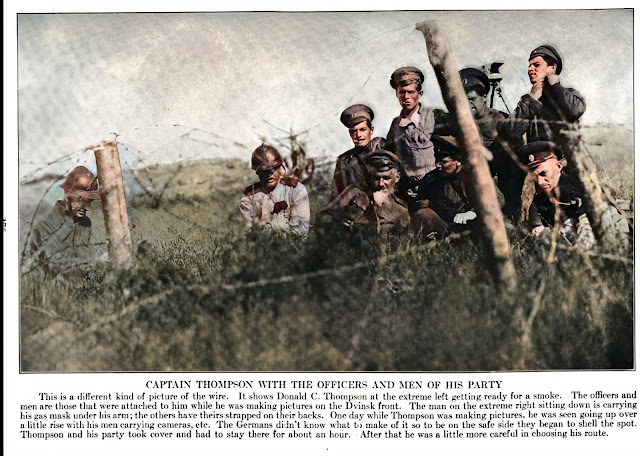


Thompson (left) at the Russian front, June 1917. Colorized picture copied from his picture book The Crime of the Twentieth Century (1918)


After a first run at the Strand Theater in New York The German Curse in Russia was released by Pathé in the USA in January 1918 as a five-reel production. We located parts of Thompson's movie in the Axelbank Collection which was used for the 1937 documentary From Tsar to Lenin. From 1920, Herman Axelbank assembled an impressive film collection on Russia, gathered from various sources. These included footage shot by several Russian cameramen. Surviving bills of sale show Axelbank also bought film sometime in the 1920s from the Jawitz Motion Picture Library in New York City, a stock film company. Although Pathé controlled distribution rights of Thompson's movie Jawitz somehow had secured Thompson's original footage, showing the events in Petrograd and Moscow during the Russian Revolution. Through Jawitz Axelbank bought Thompson's film (or parts of it) which was used by Axelbank in his edit for the sound documentary From Tsar to Lenin.

"Women's Battalions of Death"

By comparing Thompson's photographs taken in Russia, as well as publicity pictures from his movie, we could do a reconstruction of scenes that were originally shot for The German Curse in Russia. Of special interest are shots showing the all-female combat units which were formed by the Provisional Government in 1917 in a last-ditch effort to inspire the Russians to continue the war against Germany. These Women's Battalions were filmed extensively by Thompson. Axelbank's films have a scene showing its commander Maria Bochkareva and British suffragette Emmeline Pankhurst, inspecting these young female soldiers. The scene has a full match with Thompson's pictures and was no doubt filmed by Thompson.


Maria Bochkareva and British suffragette Emmeline Pankhurst, inspecting the Women's Battalion. Scene from Thompson's film The German Curse in Russia (1918) 


Axelbank probably culled many additional scenes from Thompson's film such as sequences showing the burial of the victims of the February Revolution, the demonstrations on May 1, 1917 by the Bolsheviks and the rise of the Kronstadt sailors against the Tsar. Although we have no way of knowing for sure, the World War I battle footage from Axelbank's collection has a remarkable similarity with photographs taken by Thompson on the Dvinsk front in June 1917. These could also very well have been from his film The German Curse in Russia.

Here is a link to photographs from Thompson's book The Crime of the Twentieth Century (1918) on the Russian Revolution. 

For some interesting background information on this movie here are also two articles from contemporary film fan magazines:


And now, after almost 100 years, we present you a rough reconstruction of The German Curse in Russia - how it may have looked, based on Thompson's still pictures and film scenes that were used by Herman Axelbank. Enjoy!


Wednesday, February 8, 2017

Washington Post: "An American Filmed the German Army in World War I"

Recently Michael Ruane of the Washington Post contacted us about our World War I film research. Intrigued by the Durborough film On the Firing Line with the Germans (1915), Mike wrote a wonderful article about the making of this movie and the restoration by the Library of Congress.

Here is a copy of Mike's story which was published in the Washington Post yesterday, accompanied by this clip from Durborough's World War I film.


An American filmed the German army in WWI — until they became the enemy

  
By Michael Ruane February 7 at 7:00 AM 

The young German soldier has his rifle slung over his shoulder, a half-eaten sandwich in his left hand and a drinking cup in his right.
As he steps to the refreshment window, a woman in a white apron leans over the counter and puts a sprig of flowers in a buttonhole of his uniform. He looks dashing in his spiked helmet and trim mustache, and she glances at him as he moves on.
Then she looks up at the camera.
It is June 1915, 10 months into World War I. The place is Thorn — modern-day Torun, in northern Poland. And the soldier, whose name and fate are unknown, is headed for the front lines and the killing machine of the Great War.
The moment was captured by a brash, cigar-smoking American filmmaker, Wilbur H. Durborough, and his cameraman, Irving G. Ries, who had motored to the action in a Stutz Bearcat flying an American flag, the word “press” emblazoned on the car.


George Willeman and Lynanne Schweighofer of the Library of Congress look through one of the reels of the film “On the Firing Line With the Germans” at the library’s Packard Campus in Culpeper, Va., on Jan. 10. (Jahi Chikwendiu/The Washington Post)

The scene is part of a little-known documentary about the German army — filmed by Americans — that will be part of an extended exhibit on World War I being assembled by the Library of Congress this year.
April 6 marks the 100th anniversary of the U.S. entry into World War I in 1917.
The library recently restored and digitized the silent film, which is believed to be the only existing, essentially complete American World War I feature-length documentary.
It is an hour and 48 minutes long.
Forgotten for decades, Durborough’s film, called “On the Firing Line With the Germans,” was discovered in a wine cellar of the estate of a Chicago businessman in 1985 and was eventually turned over to the library.
The footage, most of it on old nitrate film, was examined one frame at a time at the library’s audiovisual conservation center in Culpeper, Va.
It has striking scenes of youthful German soldiers before they became the enemy.
Durborough captured them in camp, peeling potatoes, marching through Berlin, recuperating in hospitals, and fighting in apparent and simulated battle scenes. Many of the images are extremely clear, and the faces of the men and women extraordinary.
He also captured scenes of Warsaw’s Jewish ghetto and vivid shots of Allied prisoners of war — British, Russian and French, some still wearing 1860s-style caps and uniforms.
There are shots of the German emperor, Kaiser Wilhelm II.
And there are scenes of Durborough — in the Stutz with cigar and driving goggles, shaking hands with German officers, chatting with German soldiers and standing in the trenches.
Indeed, Durborough, like the famous Civil War photographer Mathew Brady, appears in many of the shots he set up. “He just inserts himself everywhere,” said Lynanne Schweighofer, a Library of Congress preservation specialist who helped reassemble the film.
In mid-1915, the war, which lasted from 1914 to 1918, already had claimed tens of thousands of soldiers as Britain, France and Russia were locked in horrific conflict with Germany and its allies.
America was still neutral. And although the Germans held some advantage in the fighting, they felt they were losing the public relations contest, according to a study of the documentary by film scholars James W. Castellan, Ron van Dopperen and Cooper C. Graham.
Meanwhile, in 1914, Durborough, a seasoned newspaper photographer from just outside Dover, Del., had been assigned by Chicago’s Newspaper Enterprise Association, a news service, to photograph the war.
Then 32, Durborough was an ambitious go-getter who had worked for the Philadelphia Inquirer and the Chicago Examiner. He had covered strikes and conventions and had met Mexican revolutionary Pancho Villa.
He took the job but asked whether he could shoot moving pictures, too, even though he had little movie experience.
The association declined to pay for filming but said he was free to make a documentary as long as it didn’t interfere with his photo assignment.
Durborough got a group of Chicago business executives to invest. They hired Ries, an experienced cameraman who spoke German, and bought the Bearcat, then one of the fastest cars on the road.
And with a green light from German authorities, who were hungry for good publicity, Durborough, Ries and the Stutz sailed for Europe in early 1915.

Faces and frames that survived

Deep in the film center’s underground vaults, built into a hillside in Culpeper, concrete vault No. 53 holds, among other rare films, 42 reels of Wilbur Durborough’s documentary.
“This is all Durborough,” Geo. Willeman, the nitrate film vault manager, said recently as he gestured to multiple shelves.
The documentary and others made on highly volatile nitrate film are protected by fire alarms, smoke detectors and fire suppression systems. The temperature is kept at 39degrees, the humidity at 30percent.
In late 2014, Schweighofer and colleague Valerie Cervantes began poring over the film, guided by research done by Castellan; Graham, a retired Library of Congress film curator; and van Dopperen, who had mapped out a likely sequence of the scenes.
“It had been a dream for many people to get this thing back together,” Willeman said. “Because there’s nothing else like it — an American film about the German army in World War I.”
But many scenes were repetitive or captured on film that was damaged or in poor condition.
“We would... see which one was the least deteriorated, had the best ability to be copied, or just the best image content,” Schweighofer said. “What survived in the best shape.”
The task was done using a hand-cranked frame viewer at a spartan “rewind bench” in a special nitrate-film workroom decorated with images of movie stars. One expert would study the scenes, while another took notes on content and condition.
Once the best scenes had been selected, the film was sent to the library’s laboratory to be cleaned, repaired and stabilized. The film was then digitized.
“The thing to me was looking at the faces of the individual soldiers,” Schweighofer said. “You saw the same ones over again. You find yourself wondering what happened to them. And, if they survived this war, did they survive the next war?”
Willeman noted one scene in which German soldiers are obviously singing and enjoying themselves as they gather in front of a railroad car around a man playing an accordion.
“These guys aren’t monsters,” he said. “They’re just guys. They’re like any other army. ... A majority of these guys, a couple years after the film, were no more. They’re gone.”
Before it was over, World War I killed more than 2million German soldiers.
Young men transformed


But in June 1915, everybody looks happy at the refreshment stand in Thorn, run by the Vaterländischer Frauenverein, a patriotic women’s group.
In the scene, about 20 minutes into the film, the women at the stand walk among the soldiers, who are heading for the Russian front, handing out flowers and snacks from baskets.
As the young soldier with the mustache moves along, a woman pours a drink into his cup, and another gives him a kiss on the cheek.
He looks about 20, and, after the kiss, disappears from the frames.
He was one of thousands of soldiers Durborough and Ries filmed — most of them young, well-groomed and in clean uniforms, untarnished by combat they had probably not yet experienced.
It is only near the end of the film that the soldiers look grimy, tired and unshaven, in the wake of a battle, and where Durborough has extensive footage of ruined towns and refugees packed into rickety wagons on muddy roads.
And it is there that Durborough stops appearing in the film.
“Suddenly he vanishes,” Willeman said. “But you could see how important this has become to him, because he just goes on and on and on and on to show what’s happened.”

After the war

Durborough and Ries got back to the United States on Sept. 30, 1915, according to Graham, Castellan and van Dopperen’s study of the film.
The film was first shown in Milwaukee on Nov. 28, 1915. It began a long run in Chicago that December.
Newspaper ads described it as “The Motion Picture Scoop of the War!” Durborough often appeared at the showings and gave lectures. One promotional poster featured a portrait of the kaiser.
From Chicago, it began runs in theaters across the country. In Philadelphia in early 1916, Durborough arrived in the Stutz, driving it up and down in front of the theater where the film was showing, firing a gun to get attention.
Interest in the film evaporated in 1916 and 1917 as tensions with Germany rose. The United States declared war in April 1917.
During the war, Durborough served as an Army public relations officer.
Afterward, he gave up filmmaking and pursued various jobs in newspapers and public relations.
He was the art director and head of photography at the Philadelphia Evening Bulletin in the mid 1920s. He left the paper in 1926 and launched a series of failed business ventures, including one as a medicine salesman.
In 1931, his house outside Philadelphia went to a sheriff’s sale, according to Graham, Castellan and van Dopperen.
Durborough moved to Utah, then California, and died suddenly in San Bernardino in 1946 at age 63.


Durborough's grave at Mountain View Cemetery, San Bernardino


Ries, for his part, stayed in the film business as a cinematographer and a special-effects expert. He was nominated, with two others, for an Academy Award for special effects in the 1956 science fiction movie “Forbidden Planet.” He died in 1963.
The Stutz wound up in storage in a barn in suburban Cleveland and was sold off at auction during the Depression.
Before he died, Durborough began outlining a novel based on his life.
“You go many places very far away,” he wrote. “You go in much danger. No harm comes to you. You will be old man. ... You have happy life, then unhappy life, then in end happy again.”


Mike is a general assignment reporter who also covers Washington institutions and historical topics.


Monday, January 30, 2017

Breaking the Blockade - "The Sea Raider Möwe" (Germany, 1917)

Playing havoc with British ships crossing the Atlantic, the SMS Möwe (Seagull) was the most succesful German sea raider in World War I. Disguised as a neutral cargo ship to enable it to get close to targets, the Möwe sunk 40 ships, thus showing that the British did not completely rule the waves and that the Germans were able to break the naval blockade by the Entente. Because of its publicity value the second voyage by the Möwe was filmed by members of the crew.


Advertisement for the Möwe film from Motion Picture News, 10 April 1920. The picture on the right shows Captain Count Dohna-Scholdien adressing his crew 

Link to high res image


Original film Release

Originally released in four reels by the Bild- und Filmamt (BuFA) in May 1917 as Graf Dohna und seine Möwe, the movie became one of the most important propaganda films in the First World War. Long considered lost, parts of the Möwe film were found recently in the collection of the Dutch Film Museum EYE. A close examination of the footage shows a full match with the ship's log of December 1916 when the Möwe in quick succession sank nine ships about 700 miles off Newfoundland. So, the films were taken during the second voyage of the Möwe and therefore must have been from the original German movie produced by BuFA. Additional scenes, showing the safe return of the raider to Germany in March 1917 and Admiral Scheer congratulating Captain Count Dohna-Scholdien, have been located by the authors in historical stock footage of Periscope Films.


Scene from the "Möwe" film (1917)

During World War I the film mainly was a commercial success in German theatres. But this changed when three years later the movie was released in the United States. According to Terry Ramsaye in his classic book A Million and One Nights, the historical film was found in 1920 by newsreel cameraman Ariel Varges who sent it to America. "It was in the possession of a German secret agent. The agent had an immorata, fair but approachable. She had another gallant friend who was a chauffeur, and the chauffeur, naturally, had several friends, all fair. Captain Varges bought a lot of wine and displayed gold money."

The Cruise of the Moewe (USA, 1920)

Although it makes for a good story there is no evidence available to substantiate Ramsaye's account. Varges was in 1920 in Europe for the Hearst newsreels and trade press reports indicate he secured the film in Vienna. Introduced as The Cruise of the Moewe, "notorious scourge of the seas", the film was released in April 1920 in four weekly segments through Universal International News. After it had been edited for the newsreels, a two-reel compilation was sold by the Hearst organization in America on a state-rights basis. Parts of this American film version are at the National Archives in Washington, D.C.

Here is a video from our YouTube channel, showing all historical scenes that had been considered lost on the second voyage of the Möwe. The Dutch version has also been uploaded on the website of the International Documentary Film Festival Amsterdam (IDFA).


Monday, January 23, 2017

Albert K. Dawson, the "Kaiser's Cameraman"

While researching the online files of the National Archives in Washington, D.C. the authors recently struck gold. In Record Group 165 "American Unofficial Collection of World War I Photographs" we found a fascinating picture file on Albert K. Dawson - the "Kaiser's Cameraman" - who accompanied the German and Austrian army during World War I.


Albert Dawson, directing war films in Galicia, Eastern Front, 1915. Copied from a World War I file now at the National Archives. Colorized picture.

Link to original high res image


This record group is part of the files of the Historical Branch, War Plans Division, War Department General Staff, and was assembled by the Committee on Public Information (CPI), America's propaganda agency during the First World War. As we dug into this photo collection we found a sub file entitled "Enemy Activities - German Propaganda".  As it turns out, the U.S. government collected German propaganda pictures and they made a complete file on Dawson who was considered an interesting subject.

Most of these pictures were collected in December 1918. The description is very accurate and shows a lot more information than what must have been in the original photo captions from 1915. Presumably the editor received more information on Dawson's photographic work in wartime Europe, either from Dawson himself or from the FBI who investigated his work and produced a file on him in 1918.

Amazing Quality

We copied all of these pictures and the quality is simply amazing. There are many new photographs that we had never seen before, notably a picture showing Dawson in the trenches at the western front and another great shot showing him directing a war film in Galicia in the summer of 1915, together with his camera operator John Allen Everets.


Dawson in the trenches at the Western Front, 1915. Colorized picture.

Link to original high res image


During World War I when the United States was still neutral Dawson worked for a movie company that was funded by the Germans, producing a series of war films in America. You can read more about his film adventures in our book Shooting the Great War: Albert Dawson and the American Correspondent Film Company (2013).

We uploaded this magnificent collection to our photo channel on Flickr, and you are free to download these pictures here.


Postscript (May 2019): Dawson in Bulgaria


Dawson with the Bulgarian army. Publicity picture from Motography, 8 April 1916

Link to high res images from this trade magazine


Dawson not only filmed with the German and Austro-Hungarian army. In the winter of 1915, he also managed to get to Bulgaria, the Central Powers' latest ally. On his return from the front, he was interviewed by the Continental Times on his experiences in the Balkans. Here is a download link to this article.


Dawson in the Balkans, wearing a Bulgarian winter outfit. Publicity picture printed in Leslie's Weekly, 20 April 1916, with Dawson's personal greetings to veteran war photographer Jimmy Hare


Filming with the Bulgarian army

Information on Dawson's film work with the Bulgarians is scarce, but we were lucky recently to find a press report by New York Evening Post journalist Horace Green who accompanied Dawson during this trip. According to Green, he and Dawson were in the Bulgarian capital on Thanksgiving Day November 1915. At the Royal Palace they tried to get an interview with the Bulgarian King Ferdinand. Dawson had brought along his movie camera to make a film of the Royal couple. This was after he had received a police permit, but as it turned out the Bulgarian King and his wife did not pose for Dawson's movie camera. Green mentions both he and Dawson were tailed by an Austrian spy. He also reported Dawson shortly afterwards went to Constantinople (Istanbul).